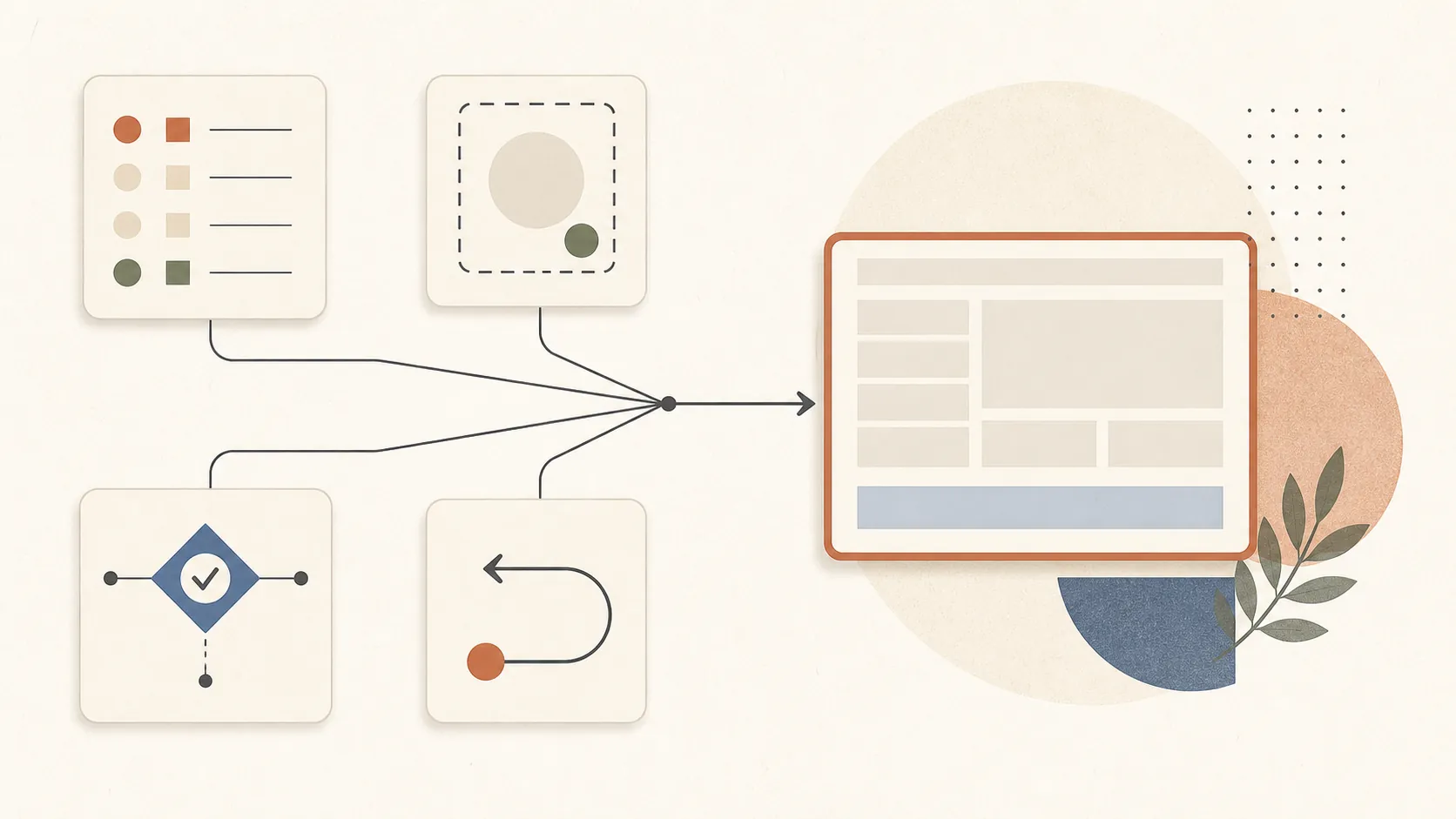
My starting point is simple: a tool matters only when it is attached to a job owned by someone. The directories reviewed organise tools by category or publish product selections, including Avenue de l'IA and Lion. That format supports discovery. It does not complete your decision sheet. I will not add another ranking or claim product tests that this article did not conduct.
Start with the job, not the tool
The first field describes an output that another person can recognise and accept. “Do marketing with AI” says nothing about the input, output, or decision owner. “Prepare a draft from an approved brief” already defines a unit of work. Naming the returned format and acceptance rule makes the choice clearer.
Write the job without a brand. This constraint stops an available feature from becoming an invented need. It also lets several candidates answer the same brief. If the sentence works only because it names a product, rewrite it until the expected result stands alone.
A usable sheet includes these elements:
- the exact input given to the candidate;
- the expected output and its format;
- the person who accepts or rejects it;
- the source, rule, or example used to check it;
- the condition that ends the trial.
This list promises no benefit. It only makes the decision readable. Candidates receive the same input and meet the same standard. The verdict stays local: suitable for this job, unsuitable for this job, or impossible to judge with the planned check.
Write down exposed data before the trial
The second field sets what the tool may receive and what stays outside its scope. Do not use “sensitive data” as a vague warning. Name the documents, fields, and content allowed in this trial. If that boundary has not been decided, pause the choice.
Separate necessity from convenience. Does the candidate need that data to produce the output, or does the connection merely avoid a manual copy? A trial may work with prepared, public, or fictional content. If that replacement destroys the meaning of the job, record the limit without treating it as permission for wider exposure.
- What does the candidate receive during the trial?
- What can it read elsewhere when connected?
- What can it change or send?
- Which requested data would stop the trial?
These answers belong in the decision, not in notes added afterwards. Check the supplier's current documentation for its practices. This article does not generalise one product's terms to a whole category.
Require a verifiable output
The third field explains how a person judges the result without trusting its tone. A fluent answer may be unusable. A plain answer may be correct. The sheet must say what the owner opens, compares, or checks before accepting the output.
For a summary, the owner finds each item in the source document and looks for additions. For an extraction, the owner compares fields with the original. For a draft, the owner returns to the brief and checks what must be present or absent. These are reading examples, not claims about any product.
| Field | Question | Evidence | Stop reason |
|---|---|---|---|
| Job | What exact output is required? | Brief and expected format | Output misses the brief |
| Exposed data | What may the tool receive or read? | Actual trial input | The job requires excluded data |
| Check | How does the owner inspect the output? | Source or checking rule | No workable check |
| Exit cost | What must be recovered or rebuilt? | Readable export or procedure | Work becomes unclear outside the tool |
| Owner | Who accepts, rejects, and stops? | A name and dated verdict | No one owns the decision |
Do not turn this table into a total score. An average hides the blocking field. A good output does not repair out-of-scope data. Fast execution is not evidence when nobody can check the result.
Assess exit cost before adoption
The next field asks what remains when you remove the candidate. The listed price is only one part of the choice. Exit cost includes the work required to recover inputs, instructions, accepted results, and an understanding of the process.
Look for a workable exit, not a prediction about a supplier. Take an accepted result. Find its input, instruction, and approval evidence. Ask another person to understand that file without opening the candidate's history. This check shows what belongs to the job and what is trapped in the interface.
- Find the original inputs.
- Recover the instructions that define acceptable output.
- Export results that must remain available.
- Remove connections and access opened for the trial.
- Give the same brief to another candidate.
If an action is not workable, narrow the scope or accept the dependency explicitly. Do not discover it after daily work has formed around the tool.
Name the decision owner
The final field attaches every acceptance, rejection, and stop to a person. “The team will check” names nobody. “Marketing will approve” does not say who may reject an output. The owner need not perform every step, but carries the verdict and knows which evidence to inspect.
The named owner also prevents the scope from expanding by habit. A new connection, a new data category, or a move from drafting to sending changes the decision. Review the sheet again. A candidate does not inherit a new right because its first output was accepted.
- accepted for this job with this input and check;
- rejected because the output fails the written rule;
- stopped because requested data exceeds the scope;
- deferred because there is no owner or workable evidence.
These statements travel. “It is the best tool” does not, because the next reader cannot see the job, boundary, date, or check behind the claim.
What is the best AI tool?
The best tool does not exist outside a job, a data boundary, and an acceptance rule. If several candidates pass the sheet, keep the choice that is easiest to explain and leave in your context. That is an operator's preference, not a product benchmark.
For the broader choice between categories, read Which AI should I choose?. The AI application decision matrix covers integration boundaries in more detail.
What is the best free AI?
Free access describes an access condition, not the quality of the decision. Check the supplier's official page when you run the trial. Then apply the same sheet. A free option that receives the wrong data, produces an uncheckable output, or traps the work does not become suitable because of its price.
Which artificial intelligence tools are most widely used?
The closed source packet does not support a reliable usage ranking. The reviewed pages publish selections and categories. They do not provide a common measure that permits a ranking here. I therefore infer no winner or usage frequency.
Popularity can help form a candidate list. It completes none of the decision fields. Take a discovered tool, submit it to the brief, and keep the verdict with its evidence. That is less theatrical than a top list and more useful to the person who owns the result.