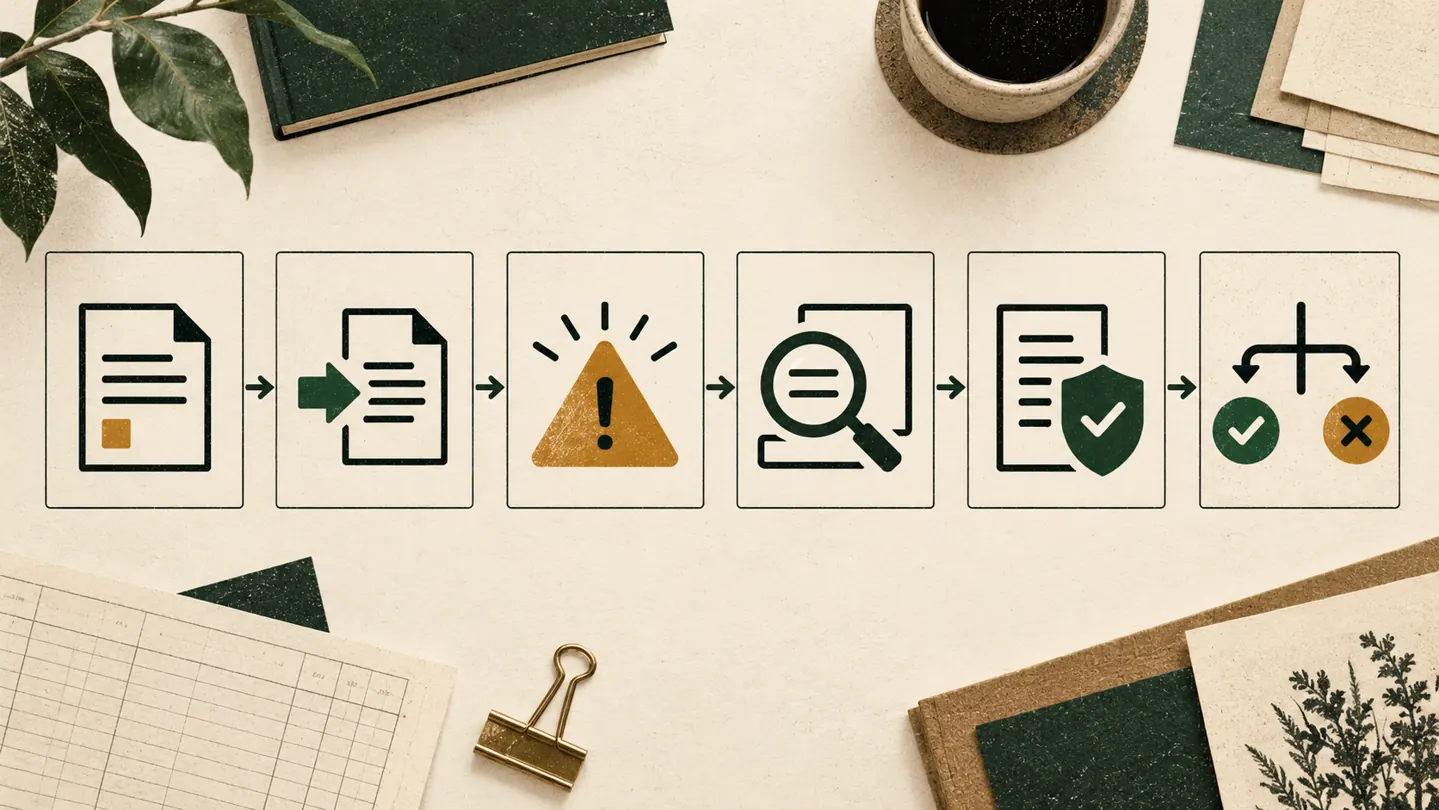
To choose a first use case, do not start with a tool or a broad promise. Isolate an accounting task whose input, output, and error are visible. Define the authorized data before the trial. Then name the person who will review every output and the evidence that person must retain. Your artificial intelligence pilot in accounting now leads to a clear decision: expand if the evidence meets the chosen criterion, correct if the error can be identified and addressed, or stop if you can neither observe the error nor provide human review. The right first task is not the one that looks most impressive. It is the one your team can examine without ambiguity, within a limited scope, with an exit rule set before the pilot starts.
Which task should you choose for a first pilot?
Write down one task, and only one. “Do the accounting with AI” does not support a decision. “Suggest a category for each supplied document” gives you an input, an output to review, and an exception to observe.
The Intec program separates regulatory research and monitoring, the analysis, classification, and interpretation of accounting data, document creation, anomaly detection, and no-code workflows. It also covers assisted writing and task automation. This list describes fields of work, not evidence of performance, reliability, or time savings (Cnam/Intec).
Before you open the pilot, complete this record:
- the exact task assigned to the system;
- the input the team authorizes;
- the error the reviewer can see;
- the human review action;
- the evidence retained for the decision;
- the rule that leads to expansion, correction, or termination.
If one field remains vague, reduce the task. The AI project requirements guide helps you record this scope without turning the pilot into a general project.
How should you complete the decision matrix?
The following matrix does not rate any product. It requires the team to connect every task to a control. Set the decision rules before the trial, then adapt them to your context.
| Task | Authorized input | Observable error | Human review | Evidence | Decision |
|---|---|---|---|---|---|
| Suggest a category for a document | Documents included in the written scope | Suggested category conflicts with the document | The team member accepts or corrects the suggestion | Suggestion, final choice, and reason for correction | Expand if the set criterion is met; correct if an error group appears; stop if the control remains ambiguous |
| Flag an anomaly in a batch | Explicitly authorized fields from the batch | Alert without a verifiable element, or a known anomaly not flagged | The manager examines the alert and the source data | Alert, reviewed data, and conclusion | Expand, correct, or stop according to the written rule |
| Prepare a file summary | Documents selected for that file | Missing or distorted information, or a statement unsupported by the documents | The reader compares the summary with the sources | Suggested version, corrections, and references used | Correct the framework if errors are identifiable; stop if they are not |
| Draft a request | Approved elements to include in the message | Inaccurate or incomplete request, or unauthorized addition | A person reads and approves it before sending | Draft, approved version, and corrections | Expand only if the review remains explicit |
| Classify documents | Documents and categories defined in the pilot | Document placed in an incompatible category | The manager confirms or changes the category | Suggested and final classification | Correct the categories or stop if the error is not observable |
| Search a document base | Authorized and identified corpus | Answer without a matching passage in the corpus | The professional opens and reads the cited passage | Question, answer, selected passage, and verdict | Expand only within the defined corpus and control |
The “evidence” column is not there to polish a report. It must make the decision reviewable. If the team cannot connect an output, its review, and the resulting decision, it lacks the material needed to judge the pilot.
Where should human review take place?
Place it between the system output and any use of that output. Describe a concrete action: compare with the document, open the cited passage, confirm a category, or read a message before sending it. “A person remains in control” is not an actionable instruction.
The reviewer needs three available actions:
- accept the output and record that choice;
- correct the output and name the observed error;
- reject the output when the review cannot support a conclusion.
This loop separates assistance from blind delegation. It also gives the review a clear object: outputs, corrections, and rejections that the team can inspect, rather than a general impression of the tool.
Which AI should you use for accounting?
The answer depends on the task and the control, not on a general ranking. Look for a capability that matches one line of your matrix. Assess a search function through the passage it retrieves. Assess a classification function through the category it suggests. Assess a writing function through the draft compared with the authorized elements.
Before you select a solution for the pilot, ask:
- Does it accept only the inputs defined in the record?
- Does the output let the reviewer find the element to check?
- Can the reviewer accept, correct, or reject without a workaround?
- Can the team retain the evidence needed for the decision?
- Can the team define in advance what triggers expansion, correction, or termination?
A convincing demonstration does not answer these questions for you. The selection becomes defensible when each capability has a task, an observable error, and a review point.
What must you frame under the GDPR?
This section is not a substitute for legal advice.
- If the system uses personal data, determine a legitimate and explicit purpose in advance (CNIL).
- Choose a legal basis before processing personal data (CNIL).
- Limit personal data to what is adequate, relevant, and necessary for the purpose, in line with the data minimization principle (CNIL).
- Assess the nature and quantity of the data, and distinguish between training and production phases (CNIL).
- Document how datasets are built, reassess risks, and govern access permissions (CNIL).
The pilot record can include these validations without interpreting them. The company AI charter can then make the usage rules visible to the team.
How do you decide whether to expand, correct, or stop?
Review the evidence against the rule chosen before the pilot. Expand only the task you observed, with the same authorized inputs and the same control. Correct when the evidence shows an identifiable error and a change to the framework can be examined in another trial. Stop when the error is not observable, the review remains imprecise, or the evidence does not support a decision.
Record the decision in one complete sentence:
- “We are expanding this task within the defined scope because the evidence meets the chosen criterion.”
- “We are correcting this part of the framework because the evidence isolates this error.”
- “We are stopping this pilot because the control does not make the error observable.”
Do not turn a local decision into general approval of “AI in accounting.” The pilot answers a narrower question: does this task, with these data, this control, and this evidence, deserve a next step?
FAQ about artificial intelligence in accounting
Which AI should you use for accounting?
Choose according to the task and expected control. The solution must accept the authorized input, produce a reviewable output, let a person accept, correct, or reject it, and allow the planned evidence to be retained. A product ranking cannot replace that match.
Can ChatGPT do accounting?
A writing or analysis tool can assist with a precisely framed task, such as preparing a draft or suggesting a classification. Do not confuse assistance with approval. A person must compare the output with the authorized elements and decide whether to accept, correct, or reject it.
Should the pilot start with the most ambitious task?
No. Choose a task whose input, output, error, and validation are observable.
Who should validate the output?
A person named in the pilot record compares the output with the authorized document, passage, or input, then accepts, corrects, or rejects it.